

 |
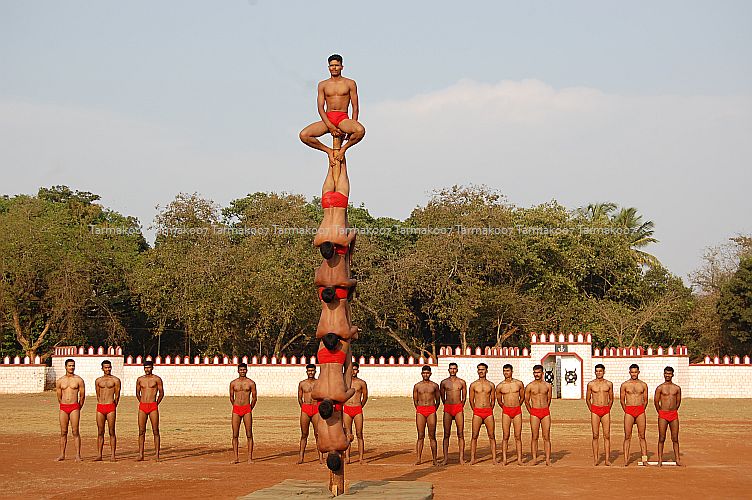
| The last 2 photos show recruits performing Lezim, while the remaining all above are from mesmerising Malkhamb moments. Photos: Shakeel Ahmed |
 By Anantha Krishnan M
Express News Service
Belgaum: The Maratha Light Infantry Regimental Centre (MLIRC) has the unique distinction of giving mandatory training for their recruits in Malkhamb, a tradtional form of sports, popular in the Belgaum and Maharashtra region. (Wikipedia says that the name has originated from the word 'malla' which means a gymnast or a man of strength and 'khamb' meaning a pole.) Every recruit who gets enrolled with MLIRC is put through rigorous sessions to master Malkhamb, a treat to watch, when performed individually or as a group.
According to Subedar Major Shivaji Mulik, the Malkhamb instructor with MLIRC, the young recruits find it difficult initially to get used to the highly-flexible moves needed on the pole. “Recruits from this region are normally well-versed with Malkhamb, but those coming from other parts of India find it tough. It takes two weeks normally for a beginner to get the balance right,” Mulik said.
For MLIRC, introducing Malkhamb into their curriculum is a way of giving the recruit an opportunity to learn popular sports form of the region. "It brings in freshness and fun. Passing the Malkhamb test is mandatory for every recruit. He has to reach the top of the pole using three grips. This exercise makes the recruits mentally and physically very agile,” says Mulik.
Along with Malkhamb, MLIRC also trains the would-be-soldiers in Lezim, a folk dance form of the region. “Both Lezim and Malkhamb are traditions from Shivaji Maharaj's time. Lezim is an entertainment programme performed during Ganhesha and other festivals. The Maratha Regiment draws inspiration from Shivaji's courageous deeds and hence we want to pass on the tradition to every recruit who joins us,” says Hawildar Dileep Patil, Lezim instructor.
For the recruits from Satara, Sangli and Kolhapur, passing the Malkhamb test is said to be an easy task. “Those from Karnataka, Kerala, Andhra Pradesh and Tamil Nadu struggle with Malkhamb. It is tough, but it is possible. It's all about applying the right kind of force at the right time. It's also about balance. If you have the will, you can twist your body the way you want. You can make it listen,” says Havildar Dadasahib Sutar, Drill Master, MLIRC.
After learning Malkhamb, the recruits are said to have shown improvements in their running skills. “It helps to strengthen the leg muscles. Once you master the art, it is an addiction,” says Sutar. The MLIRC recruits have performed Malkhamb during various military functions across the country. They are also said to be in great demand during all joint training sessions with the foreign armies.
(Series concluded)
(Copyright@The New Indian Express)