Tarmak007 -- A bold blog on Indian defence: Sukhoi (Su-30MKI)

For regular updates, visit: https://www.facebook.com/Tarmak007

Clipart Clipart Clipart Clipart Clipart Clipart Clipart Clipart Clipart

Showing posts with label Sukhoi (Su-30MKI). Show all posts

Tuesday, December 27, 2011

EXPRESS INVESTIGATION: 2 | IAF had enough time to build shelters for Sukhois


By Anantha Krishnan M

Express News Service

Bangalore: Exposed Sukhois are in the danger of having nick marks on the engine blades, though the thrust vector part is generally covered. With a transparent (opaque) canopy, the heat gets settled inside, slowly, but surely impacting on multiple non-metallic parts, including those linked to ejection systems. While the Indian Air Force (IAF) failed to give a detailed response to our queries, sources flying and feeding the Sukhois told Express that the shelter-less state of affairs of a modern fighter is 'shocking.'     
HAL officials are amused as to why the IAF didn't bother to provide shelters to the fighters' biggest bases at Pune and Barelley. “The IAF had enough time from 2002 onwards to put up shelters in Pune. Weather has an impact on the fighters if they are parked outside,” sources said. HAL's first official communication, expressing serious concerns, is said to have been sent to the IAF's Maintenance Command in October 2010. The IAF operates over 150 Sukhois from its bases in Pune, Barelley, Chabua, Jodhpur and Tezpur.
Sources said that even lightning strike didn't spare a Sukhoi in 2009 causing serious emergency. “The aircraft suffered structural damages, which is unheard of in modern times. All these are definitely pointing towards quality and design issues. If we don't address them now and take corrective steps, it will be a bad publicity for the IAF, HAL, and to both friendly nations of India and Russia. At what cost are we losing them?” a veteran pilot, who were among the first to fly the Sukhois, said.
An official with the Centre for Military Airworthiness and Certification (CEMILAC) says that the all Russian aircraft are designed for safe operations in minus temperatures. “If the Sukhois are parked outside, even with a canvass cover, it cannot escape from the trapped temperature inside, which will be very high as compared to the reflected temperature. We don't have much insight into the Russian qualification process,” the official said. He claimed that for Indian military platforms (Tejas, Dhruv, Sitara) the rubber parts are tested and qualified to a maxim temperature of 71 degrees Celsius.
Air  Marshal (Retd) T.S. Randhawa, an expert with Sukhoi platforms, said that the IAF is already in the process of getting shelters. “We understand that there can be an effect due to exposing the fighter to sun. The weather varies –  like hot, cold, dust, breeze and over a longer period of time, YES, there could be an impact. But, these fighters are serviced as per the IAF SOPs,” he said.    
SUNBURN: The possible damage to Sukhois due to prolonged exposure to the sun: 
  • Flexing on fuel tanks leading to leakages
  • Effect on avionics resulting in premature failures
  • Impact on ejection system due to transparent canopy
  • Damage to fabric material of pilot seats
  • Wakening of harness units
  • Nick marks on engine blades due to dust particles
| Copyright@The New Indian Express |

PART-1 HERE

Wednesday, December 21, 2011

Chief scores some Browne Points with Su flight!

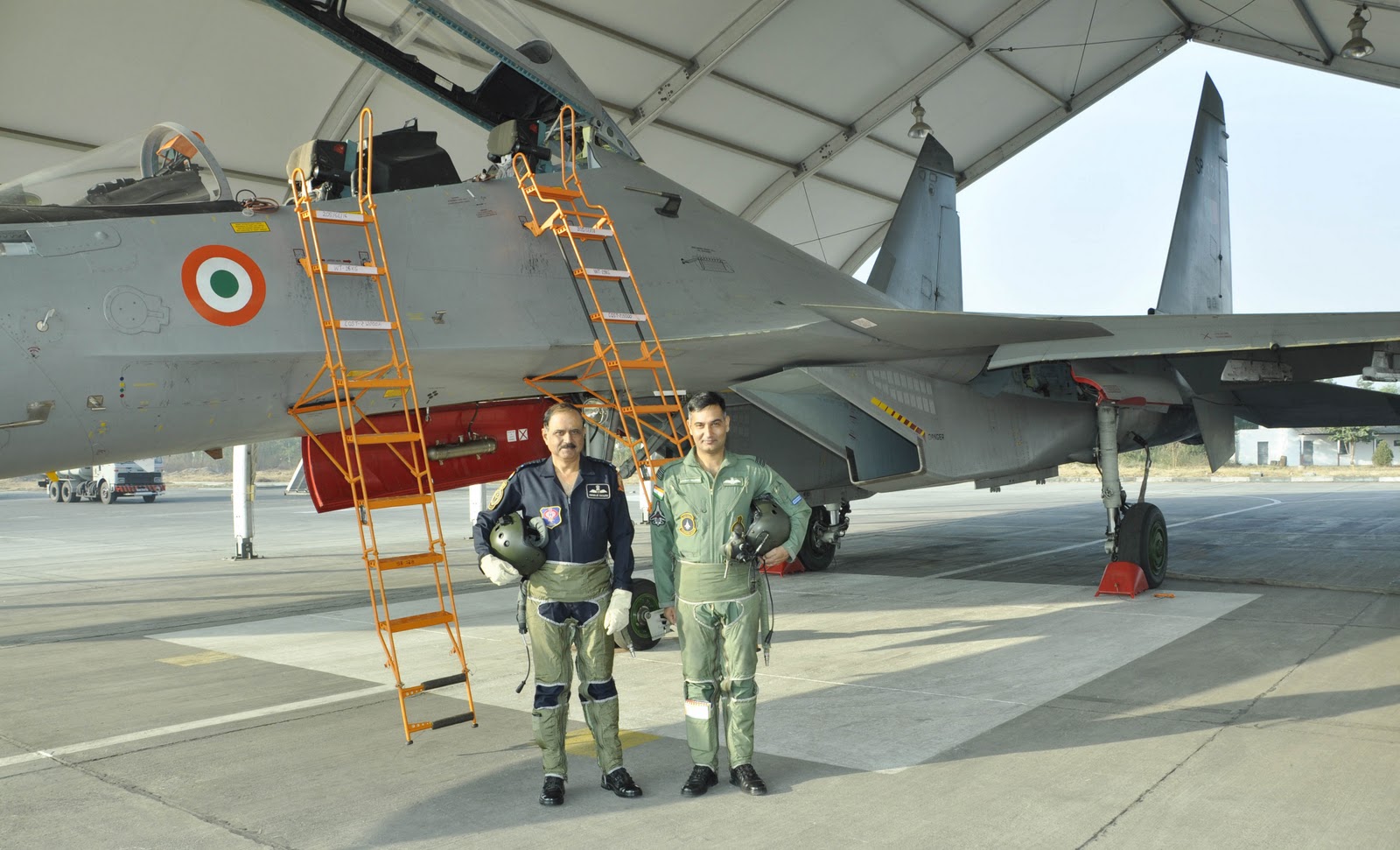
(Photo 1) Air Chief Marshal NAK Browne, Chief of the Air Staff with Wing Commander Anurag  Sharma, Commanding Officer, SU-30 MKI Squadron, before the sortie at Pune Air Base on December 21.  (Photo 2 & 3)  The CAS at the base. Photos: IAF

Air Chief Marshal NAK Browne, Chief of the Air Staff flew a one hour sortie in a SU-30 MKI at Pune airbase today, an official release from CAS' media managers claim.
Quoting the Chief, the release says: "I wanted to be here to not only fly the SU-30 MKI but also to meet all of you and assure you that our SU-30 fleet is in good and capable hands. Our boys have been doing an excellent job and the momentum of building up the new SU-30 Squadrons needs to be maintained. Our people should remain our highest priority because it is then, that a cohesive team translates itself in to a success story.”
The CAS was on a working visit to this base, which he had previously commanded as the Air Officer Commanding (AOC), from 2001 to 2003. During his visit he interacted with the Squadron pilots, engineers and all the station personnel and met the key appointments of the station.
Watch this space for Sukhoi-related news soon. Very soon!

Wednesday, November 2, 2011

Desi Sukhoi performs supersonic ballet on debut | Aircraft built from complete raw material phase makes a silent entry

  
By Anantha Krishnan M
Express News Serrvice
Bangalore: The made-in-India Sukhoi (Su-30MKI) is up and flying. Amidst the Diwali light and sound show around, the Ozar air base in Nasik witnessed a silent, yet stellar affair. The desi Sukhoi, a 4.5 generation fighter, took to the skies for the first time and performed a 55-minute supersonic ballet. Also flying high was the swadeshi pride considering that this was the first aircraft manufactured from a complete raw material phase. The striking feature was the pilots pulling 9g at the first attempt itself, a strong pointer towards its structural integrity.
Indian Air Force (IAF) sources confirmed to Express that the Sukhoi was piloted by Wg Cdr S C Sharma with co-pilot Wg Cdr S S Mallick in the rear. The Aircraft Manufacturing Division of Hindustan Aeronautics Limited (HAL), Nasik, produced this metal bird with close to 28,000 parts and using 1,20,000 tools.
“This flight was undertaken with full confidence in the technical prowess and expertise of HAL. It went smoothly as planned without any hitch. The aircraft handled beautifully and all the systems behaved as required. We cloaked an excellent flight,” the pilots were quoted by sources, from their debrief session, soon after the touch-down.
HAL has so far delivered 99 Sukhois to the IAF, out of a total order of 180 aircraft, produced under licence from Russia at an approximate cost of Rs 250-300 crore each. The raw material phase Sukhoi is the first from Phase-IV of the project. The avionics and accessories have come from HAL’s Lucknow, Hyderabad and Korwa Divisions, while the engine was produced at the Koraput Division.
“As per the original compressed programme, they (HAL) will have to complete the deliveries by 2014-15. It is unlikely that this deadline will be met now and we expect a delay of three years,” IAF sources said. Express has learnt that the delay in design and development phase of Sukhoi in Russia impacted the receipt of technology and tooling in India. In addition, HAL too had issues in absorbing new technologies and setting up of capital infrastructure.
The Sukhoi’s powerplant (AL31FP) -- a technology marvel by itself -– is specially modified with vector thrust jet nozzle (for high flexibility and maneuverability of the aircraft). It has modular construction ensuring higher technological characteristics of assembly, operation and flexibility at the IAF bases.
The icing on the cake of this India shining story is that 90 per cent of engineers, designers, technicians and managers part of this homegrown project are youngsters in the average age group of 25 to 40 years. The IAF pilots will now test-fly all the profiles before the final acceptance of the aircraft.

For regular updates, visit: https://www.facebook.com/Tarmak007