Showing posts with label AVIATION WEEK. Show all posts
Saturday, February 12, 2011
More snaps from Aviation Week's A.R. Jose
Labels:
A.R. Jose,
Aero India 2011,
AVIATION WEEK
Saturday, February 5, 2011
An interesting Aviation Week perspective on MMRCA race
Video Courtesy: Aviation Week
Labels:
AVIATION WEEK,
MMRCA
Wednesday, January 12, 2011
Tejas production method in HAL needs to be well-oiled; 100% indigenization in defense not possible: Saraswat
(INDIA THOUGHT LEADERS INTERVIEW SERIES IS ANCHORED BY THE BLOGGER FOR AW)
India’s Defense Research and Development Organization (DRDO) is finally making progress with many homegrown projects. Often on the receiving end of time and cost overruns, DRDO has been kept on its toes by the Indian media, audit agencies, experts and the armed forces. Amidst all the brickbats and occasional bouquets, DRDO held firm, and slowly the products started gaining acceptance by India’s armed forces. India’s industries also came of age and showed increasing confidence in partnering with DRDO. At the helm of DRDO’s affairs is India’s leading missile scientist, Dr. V.K. Saraswat, who is also the scientific advisor to India’s defense minister. “I am for international collaboration and don’t believe in 100% indigenous development, which is not possible in the current scenario. I don’t believe in reinventing the wheel. Development has to be collaborative,” Saraswat tells Anantha Krishnan M., Aviation Week’s Senior Aerospace and Defense Correspondent (India), in a one-on-one interview for the India Thought Leaders (ITL) series. (Below is the gist of the interview.)
On DRDO’s bumpy ride: The last 20% completion phase of various projects needed more time and extra focus than what the initial 80% took and needed extra focus. This was the period, maybe for close to two decades until around 2005, [when] we found that the output was very fluctuating. This became a major sore point as the country and armed forces were concerned. The users thought we were not delivering. Hence, we decided to channelize all our energies toward the critical 20% of the phase in the last two years.
On LCA production: My assessment is that there should be much more effort from the production agencies to take the Tejas program forward. What is required for the production of Tejas, a lean manufacturing process should be in place. We must have good supply chain lines, good contractors (tier I, II) and state-of-the-art tooling systems. We should have excellent methods of contracting, monitoring, evaluating and integrating every work. While we have some of these in patches, HAL needs to consolidate all this into a great process. An efficient production method is yet to be put in place by HAL as far as LCA is concerned.
India’s Defense Research and Development Organization (DRDO) is finally making progress with many homegrown projects. Often on the receiving end of time and cost overruns, DRDO has been kept on its toes by the Indian media, audit agencies, experts and the armed forces. Amidst all the brickbats and occasional bouquets, DRDO held firm, and slowly the products started gaining acceptance by India’s armed forces. India’s industries also came of age and showed increasing confidence in partnering with DRDO. At the helm of DRDO’s affairs is India’s leading missile scientist, Dr. V.K. Saraswat, who is also the scientific advisor to India’s defense minister. “I am for international collaboration and don’t believe in 100% indigenous development, which is not possible in the current scenario. I don’t believe in reinventing the wheel. Development has to be collaborative,” Saraswat tells Anantha Krishnan M., Aviation Week’s Senior Aerospace and Defense Correspondent (India), in a one-on-one interview for the India Thought Leaders (ITL) series. (Below is the gist of the interview.)On DRDO’s bumpy ride: The last 20% completion phase of various projects needed more time and extra focus than what the initial 80% took and needed extra focus. This was the period, maybe for close to two decades until around 2005, [when] we found that the output was very fluctuating. This became a major sore point as the country and armed forces were concerned. The users thought we were not delivering. Hence, we decided to channelize all our energies toward the critical 20% of the phase in the last two years.
On LCA production: My assessment is that there should be much more effort from the production agencies to take the Tejas program forward. What is required for the production of Tejas, a lean manufacturing process should be in place. We must have good supply chain lines, good contractors (tier I, II) and state-of-the-art tooling systems. We should have excellent methods of contracting, monitoring, evaluating and integrating every work. While we have some of these in patches, HAL needs to consolidate all this into a great process. An efficient production method is yet to be put in place by HAL as far as LCA is concerned.On the missile front: The focus of DRDO in the next five years will be to build a subsonic cruise missile for multi-platforms. The work has already begun. Now we are focussing on major building blocks for the missile, which means engines. We will begin work on loitering missiles. We are looking at launching multiple sub munitions from a low-cost rocket or a missile, which can be guided against each target.
New areas: The most neglected area is gun development, and we have already started work in this area. We want to develop even the engine in India for FMBT and have launched a national program involving private industries, academic institutions and DRDO.
On international collaboration: I am for collaborations. The whole idea is to accelerate our pace of development and avoid reinventing the wheel. I personally don’t believe in the 100% indigenous philosophy, which is the most impractical one. Today, if anyone wants complete homegrown products in critical areas, it is because of the lack of [understanding] of the dynamics of the market and a lack of understanding of what is global competitiveness.
On DRDO revamp: We are making good progress. We are implementing 20 to 30% of the Rama Rao Committee recommendations on DRDO’s makeover. The complete decision-taking process has been decentralized. Delivery will be the watchword for DRDO’s progress.
The full interview in:
Wednesday, December 22, 2010
India Thought Leaders: India will need $8.8b worth of missiles & systems in 5 years: Chander
| By Anantha Krishnan M. | AVIATION WEEK |
Bangalore | India | December 21, 2010 |
India’s Defense Research and Development Organization (DRDO) has set its sights on some big-ticket missile projects, driven by a new philosophy aimed at combating program delays, cost overruns and controversies. The man in the thick of the action is Avinash Chander, director of DRDO’s Hyderabad-based Advanced Systems Laboratory (ASL), who has been developing some critical programs, especially the Agni class of missiles. With industry showing signs of confidence in being party to India’s future missile missions, Chander feels the time has finally arrived to step on the gas with renewed focus. “There were many issues in the past with our missile programs and we have analyzed them all threadbare. It is an era of collaboration, sharing one’s strength. DRDO, [for] its part, has also realized that the success mantra for our survival is to deliver quality products on time,” Avinash tells Aviation Week during the India Thought Leaders (ITL) interview series.
AW: What kind of potential are we looking at for India’s missile programs?
A.C: For the first time, India is seeing a huge potential in missile programs. It is predicted that we will need Rs 40,000 crore ($8.8 billion) worth of missiles and systems in the next five years. We haven’t seen this kind of a magnitude before. There’s a huge potential for long, medium, [and] short-range surface-to-air missiles (LR-SAM, MR-SAM and SR-SAM). Then there’s a need to develop more anti-tank and anti-radar missiles. Another area in focus is precision-guided munitions (PGMs) and shoulder-fired weapons. The list is long and we have to work concurrently to meet the needs.
To become a blog member,
Sunday, November 7, 2010
Interview with IAF Chief: We are focusing on network-centric warfare capabilities; we believe quality of HAL products will improve with entry of private players
Chief of Air Staff Air Chief Marshal P.V. Naik. Photo: IAF
The Indian Air Force turned 78 on Oct. 8, and just two weeks later the IAF held its four-day biannual Commanders’ Conference Oct. 26-29, touching on issues ranging from operational preparedness and philosophies to maintenance, upgrades, HR, acquisition, and administration. As part of its aggressive modernization mission, the IAF is waiting in the wings to acquire new assets and upgrade some of its fleets. “We need to continuously train and evolve to become a capability-based force. We are honing our skills in cyberwarfare and concentrating on building network-centric warfare capabilities to boost our combat efficacy,” Chief of Air Staff Air Chief Marshal P.V. Naik tells Aviation Week’s Senior Aerospace and Defense Correspondent (India) Anantha Krishnan M. during the India Thought Leader (ITL) interview series. This interview mainly focuses on IAF’s philosophies toward its air warriors, support for homegrown projects and readiness to take on future challenges.
AW: IAF has grown one more year old this October. What are the challenges the air warriors will face in the next 5-10 years?
P.V.N.: I would say that the IAF has matured one more year. And this maturity is accentuated in the way we continue to evolve our warfighting doctrines and training methodologies, with a greater emphasis on harnessing the potential of human resources to achieve our objectives. Air warriors in the IAF are alive to the ever-changing strategic environment. As you know, we have embarked upon an all-round modernization plan which aims to replenish our fleets, upgrade airfield infrastructure and acquire modern radars and weapon systems. Therefore, one of the major challenges is the co-habitation factor – that of maintaining the existing fleet and, at the same time, assimilating the modern technologies coming our way. We are fortunate to have a highly professional HR pool – one which is rich in exposure and has demonstrated a great deal of adaptability in absorbing modern technologies. We are also honing our skills in cyberwarfare and concentrating on building network-centric warfare capabilities to boost our combat efficacy. In a nutshell, we will need to continuously train and evolve to become a capability-based force, one which is more than capable to meet all the challenges of the future.
AW: Often we read media reports and comments being made by senior IAF officials about the depleted squadron strength of IAF. What are the quick steps that need to be taken to strengthen the IAF?
P.V.N.: It’s a known fact that the IAF’s fighter fleet is depleting due to phasing out of MiG-21 and MiG-23 aircraft. Both these aircraft served us well. Even the strength of the MiG-27s has been reduced to half the original. While technological obsolescence is an inevitable phenomenon, there is a need for concurrent replenishment of our combat inventory. As you are aware, the Light Combat Aircraft project has overshot production time frames. The MMRCA would take at least 4 years to fully fructify. However, it would be unwise to base our combat efficacy solely on classical numerology – that of having the required numbers. New squadrons of Su-30 MKI are being raised and midlife upgrades of [the] Jaguar, Mirage-2000 and MiG-29 fleets [are] on the anvil to improve our combat effectiveness. The induction of force multipliers like FRAs and AWACS has enhanced our combat effectiveness. So while depleting strength is a concern, it is equally true that we have maintained our combat edge through new inductions and upgrades and the IAF is fully capable today of thwarting any threat.
(The full interview appeared in Aviation Week on Oct. 29, 2010)
click on the logo below:
To read the full interview with IAF Chief, please
click on
Newsbreaks will first appear on AW sites
and a gist would then be up on this blog.
Tuesday, October 5, 2010
Car Nicobar IAF base to add new assets
By Anantha Krishnan M./ AVIATION WEEK/ Port Blair/ October 4, 2010
The Indian Air Force (IAF) base in Car Nicobar soon will have a full-fledged flight detachment, and a medium power radar (MPR) will be commissioned by 2012. “The MPR will further add teeth to the base,” Wing Cdr. M.S. Sridhar, officiating station commander, tells AVIATION WEEK. “We have a Rohini radar now with limited ground control interception. We will also have an air defense weapons squadron.” The base falls under the Andaman and Nicobar Command (ANC), which has plans to upgrade the facility so all IAF platforms can operate from here. The site sustained severe damage in the December 2004 tsunami. “We lost close to 130 [people] from IAF during [the] tsunami and we have now completely reconstructed the base,” Sridhar says. “The runway was the key. It acted as the lifeline to people here, and it, too, was redone four months after the tsunami. The base had subsided by 1.2 meters, post-tsunami.”
(For the full story, please visit the Aviation Week link below:
Wednesday, September 29, 2010
Navy gears up to add another floating dock in Port Blair by 2014; FDN-2 will cost Rs 250-300 crore
| The FDN-1 in Port Blair is Asia's only such facility. Photos: Indian Navy |
| By Anantha Krishnan M. | AVIATION WEEK |
Port Blair | India | September 28, 2010 |
![]() |
| AVIATION WEEK ANDAMAN SERIES-1 |
The Indian navy soon will add one more floating dock to repair and refit warships at sea. The request for information (RFI) for the second Floating Dock Navy (FDN) facility was issued to shipbuilders worldwide in March.
The new facility will be smaller than the existing one and will be ready by 2014. It could lift up to 8,000 tons once fully operational and is expected to cost around Rs 250-300 crore ($55-66 million).
The FDN-1 comes under the Andaman and Nicobar Command (ANC), headquartered at Port Blair. It is the only such facility in Asia, and the Indian navy sees it as strategically located due to its ability to refit a ship. The ANC also is known as India’s only triservice command.
The FDN-1 is the second-largest vessel of the Indian navy, following its aircraft carrier, but falling short only by 2.2 meters. Built by IHHI of Japan in 1987 at a cost of Rs 20 crore, it can dock all Indian navy vessels except carriers and oil tankers.
“These are maintenance-intense docks and are supported on 12 anchors. It can lift up to 11,500 tons,” says Commander A.K. Sharma, officer-in-charge of FDN-1.
For the full story, please visit
the Aviation Week link below:

Thursday, September 16, 2010
Chandipur to Chitradurga! DRDO's new test range in Karnataka on track; 2nd facility after ITR near Balasore
| By Anantha Krishnan M. | AVIATION WEEK |
Bangalore | India | September 15, 2010 |
A new test range for India’s Defense Research and Development Organization (DRDO) is being built in the Chitradurga district of Karnataka state. Dr. Prahlada, chief of DRDO, tells AVIATION WEEK that a new facility also will be constructed in Hyderabad for DRDO to flight-test aircraft.
The Chitradurga facility will focus on flight tests of unmanned aerial vehicles, air-to-ground weapons, parachutes and electronic warfare systems.
“We are going for the best of systems and facilities, and in the coming years DRDO will have multiple facilities for the testing of its wide range of platforms,” Prahlada said at the Bangalore Defense and Aerospace Journalists’ Forum.
The new Chitradurga test range will cover 4,000 acres and will have a runway. DRDO already has acquired the land.

Saturday, August 28, 2010
India Thought Leaders (ITL): India will be a force to be reckoned with In MAV segment, says Lt. Gen. (Ret.) V.J. Sundaram

Lt Gen (retd.) Dr V.J. Sundaram's passion, even at 75 years, is probably the stimulant for the Rs 100-crore national program for MAVs. Photo: Bhaktar Babu/Bangalore Beat
| AVIATION WEEK | Bangalore |
India | August 27, 2010
India’s National Program for Micro Air Vehicles (NP-MICAV) is finally on the launch pad, with the Defense Research and Development Organization (DRDO) and Department of Space and Technology (DST) sponsoring the Rs 100 crore ($21.5 million) mission. Eighty-two different projects in five years might sound too ambitious, considering the delays that Indian aerospace and defense projects often run into. But the team, consisting of experts from the Aeronautical Development Establishment (ADE), National Aerospace Laboratories (NAL), National Design and Research Forum (NDRF), Indian Institute of Science, and Indian Institute of Technologies, as well as academic institutions and private industries, are confident that India will emerge as a force to be reckoned with in the MAV/NAV segment.
After spending three days with the NDRF team covering their activities, including MAV test flights, AVIATION WEEK’s Senior Aerospace and Defense Correspondent (India) Anantha Krishnan M. caught up with Lt. Gen. (Ret.) Dr. V.J. Sundaram, Advisor, Micro and Nano Systems, NDRF, to get an up-close view of the NP-MICAV program, which is undoubtedly the most exciting joint mission that Indian scientists have undertaken in many years. “It’s a huge challenge ... we need to develop intelligent flying machines that ought to be smaller and smarter,” says Dr. Sundaram – an icon in India’s missile programs – in the India Thought Leaders (ITL) interview series.
AW: What prompted the NDRF to get into the MAV segment?
V.J.S.: I am from the Indian Army and we faced a lot of issues during disaster management. The civil administrations were often clueless as to what needs to be done in an emergency and demanding situation. So the idea came up to have some simple and effective system that can be operated by anyone to assess the levels of natural disasters. Later on, there was a need to have these platforms for homeland security in the wake of increasing terror activities. Even the Indian Army can use these MAVs to check the happenings around a battalion. With a very large network of engineers, scientists and institutions available, we knew we could make an impact.
Join the movement for unsung heroes:
Saturday, August 14, 2010
India Thought Leaders (ITL): Participation In defense offset program our prime target, says Maini Global Aerospace CEO Palta
Naresh Palta, CEO of MGA (above) and the firm' products for aerospace below. Photos: t-arch-2010-sikka
By Anantha Krishnan M. | Aviation Week |
Bangalore | India | August 14, 2010
The Maini Group, based in Bangalore, is a fast-growing private firm that has made huge inroads in high-precision and innovative engineering products since 1973. Since 2004, the group’s flagship company, Maini Precision Products Pvt. Ltd. (MPP), has been exporting aerospace-machined, high-precision components to leading aerospace companies. In February 2009, the aerospace activity was formed as a fully focused entity under Maini Global Aerospace Pvt. Ltd. (MGA). Spearheading MGA’s activities is its CEO, Naresh Palta, a man with more than 40 years of rich experience in aerospace and defense. “Our objective is to diversify and grow into wider areas of aerospace like sheet metal forming, aircraft structures, aircraft accessories and ground-support equipment, ultimately providing and end-to-end, one-stop shop from engineering to product delivery,” Palta tells AVIATION WEEK, during an interview for the India Thought Leaders (ITL) series.
AW: What was the driver for your company to go into aerospace?
N.P.: MPP was established with the single-minded objective to take the ‘Made in India’ tag of precision engineering products, made to international quality standards, into the global market. Having successfully done that and after creating a formidable clientele in hydraulics and the automotive industry in Europe and the U.S., MPP was looking for higher challenges. Aerospace, with its stricter standards, norms and demands, was a natural choice. MPP follows international standards and has acquired the requisite international certifications like AS9100, ISO 14001 and NADCAP.
Saturday, June 26, 2010
India Thought Leaders: ADA boss PS says Tejas' ownership among users have gone up; we have taken the blow, but we have delivered too
India’s Light Combat Aircraft (LCA-Tejas) program boss P.S. Subramanyam (above) and his pet metal bird Tejas performing a stunning manoeuvre (below). Photos: t-arch-20010
By Anantha Krishnan M. | Bangalore, India |
June 25, 2010 | DNA (India)
By Anantha Krishnan M. | Bangalore, India |
June 25, 2010 | DNA (India)
Tejas, India’s light combat aircraft (LCA), is finally giving goose bumps to thousands of engineers, designers, scientists and technocrats. The limited series production (LSP) platforms are hitting the sky like nobody’s business. There’s excitement in the air. There’s hope. And there’s a goal that’s just within their reach. Amidst all the news of the initial operational clearance (IOC) within sight and the near-services version configuration (LSP-4) flying recently, one man is calm and composed, for he knows the end of one journey is just the beginning of another. In a one-on-one with Aviation Week, as part of the India Thought Leaders (ITL) interview series, Program Director (Combat Aircraft) and Aeronautical Development Agency (ADA) Director P.S. Subramanyam (known among close peers as P.S.), says the technological knowledge gained through the Tejas program is sure to make India a force to be reckoned with in all future military plane-making missions.
A.W.: No other program has received so much media bashing in addition to genuine concerns from your users. What was the motivational thread you adopted during these difficult times?
P.S.: I don’t want to comment on the media, though at times we did think of putting [in] a firefighting plan to counter one-sided remarks in the press. Later, we decided against it, knowing that it would divert our focus from the main goal. Yes, we had difficulties as we were attempting to do something that has never been done in this country. Yes, we slipped because we had to face many challenges from different quarters while mastering technologies. But don’t forget the fact that my team took the blow but finally delivered. Now, to the users. We understand their concerns and even they, too, are aware of our constraints. The project has definitely received a huge push after a project management team from IAF started functioning from ADA. They are the pacemakers for the program now and involved in every bit. This has also increased the ownership feeling among the users.
www.aviationweek.com/india

Saturday, June 19, 2010
India Thought Leaders: HATSOFF Will Revolutionize Helicopter Training In India, says Upadhyay
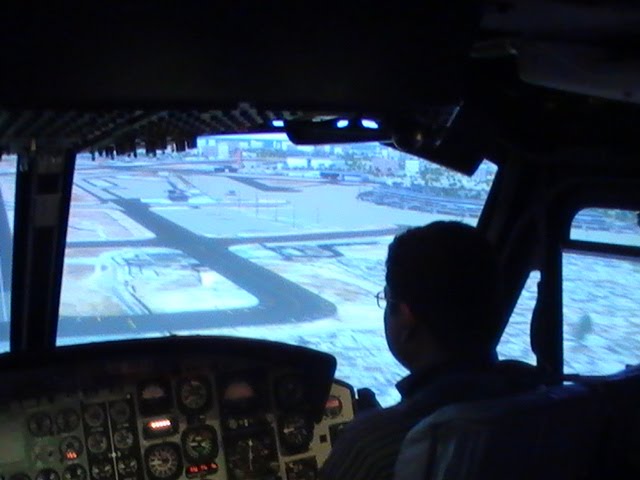
The Bell simulator (above) and (below) Capt Krishna, Chief of Training, during a sortie above Mumbai airport, sitting in Bangalore!
The flying fraternity in India will hopefully give a standing ovation to the man above -- Wg Cdr (Retd.) C.D. Upadhyay, CEO, HATSOFF -- for running from pillar to post to gift India, probably one of the most-sophisticated helicopter simulation facilities. Photos: t-arch-2010
By Anantha Krishnan M. | Aviation Week
Bangalore, India | June 18, 2010
The Helicopter Academy to Train by Simulation of Flying (HATSOFF) – a 50/50 joint venture between Hindustan Aeronautics Ltd (HAL) and simulation technology company CAE, Canada, is finally ready to go live. Though the facility’s official inauguration may not be until September, the Rs 300 crore ($65.2 million) high-tech facility is set to informally go live next week. The first Bell 412EP cockpit is ready for training, and the European Aviation Safety Agency (EASA) has already granted its certification, with approval by another agency pending. AVIATION WEEK spoke to Wing Cmdr. (ret.) C.D. Upadhyay, the CEO of HATSOFF, as part of its India Thought Leaders (ITL) interview series.
AW: How significant will the contribution of HATSOFF be to the Indian helicopter industry?
C.D.U.: It has been recognized all over the world and at the highest levels in Indian aviation, including the Civil Aviation Ministry, that there is an urgent requirement for simulator(s) for helicopters flying in India due to a significantly higher rate of human error contributing to helicopter fatal accidents. Human error in helicopter accidents is higher by an order of magnitude when compared to fixed wing aircraft. We at HATSOFF are confident that the simulator training which we will be imparting to the helicopter pilots will soon reduce this factor in helicopter accidents. Besides the flight safety aspect, we are also very sure that the recurrent training and other forms of training which will be given at HATSOFF will maintain and improve the professional efficiency of helicopter pilots to meet the challenging tasks of the 21st century.
Tuesday, June 15, 2010
AVIATION WEEK: Tejas squadron to be rasied in Bangalore before moving to Sulur; LSP-3 & PV-3 back after successful hot-weather trials
Bangalore, India | June 14, 2010
The Indian Air Force (IAF) will form the first squadron of the light
combat aircraft (LCA) Tejas in Bangalore next year before it is moved
to Sulur, IAF Vice Chief Air Marshal P.K. Barbora tells AVIATION WEEK. (Sulur is located near Coimbatore, Tamil Nadu.) The
initial formation of the LCA squadron in Bangalore is primarily due to
IAF’s proximity to the aircraft’s designer, the Aeronautical
Development Agency; its manufacturer, Hindustan Aeronautics Ltd. (HAL);
and IAF’s test pilots’ unit, the Aircraft System Testing Establishment.
In addition, the National Flight Test Center (NFTC), which is
monitoring all LCA-related flying activities, is also within HAL’s
military airport. "Training becomes easier in Bangalore for
the IAF pilots on the new platform. In addition, any teething problems
that the pilots might face while getting accustomed to Tejas can be
sorted out before they move to Sulur,” an NFTC source says.
Phase-II hot-weather trials over: Meanwhile,
Tejas crossed a significant hurdle when two LCAs successfully performed
in hot-weather trials (HWTs) at Nagpur last week. Sources told AVIATION
WEEK that the week-long HWTs were part of Tejas’ phase II schedule. The
first phase was completed in 2008. “All new systems onboard
and avionics were tested with temperatures varying from 40 to 45
degrees Celsius (104 to 114 deg. F.). We had absolutely no issues with
these flights, and both platforms rose to the occasion and performed as
expected. We had close to 10 flights as part of the trials,” a source
says. Confirming the successful
HWTs, P.S. Subramanyam, program director for combat aircraft and
director of the Aeronautics Development Agency, says that one limited
series production-3 aircraft and another prototype vehicle-3 from the
Tejas fleet were part of the HWTs at Nagpur.
For leaving your comment on LCA program, do hit the link below and partake in tarmak007 debate (tD-2).
http://tarmak007.blogspot.com/2010/06/tarmka007-debate-td-2-indias-lca.html
Labels:
ADA\LCA,
Air Marshal P.K. Barbora,
AVIATION WEEK,
FOC,
Indian Air Force,
IOC,
NFTC,
P.S. Subramanyam,
tarmak007
Subscribe to:
Posts (Atom)