Tarmak007 -- A bold blog on Indian defence: Indian Air Force (IAF)

For regular updates, visit: https://www.facebook.com/Tarmak007

Clipart Clipart Clipart Clipart Clipart Clipart Clipart Clipart Clipart

Showing posts with label Indian Air Force (IAF). Show all posts

Sunday, September 17, 2017


Pranams to Marshal of Air Force Arjan Singh
.

Tuesday, June 16, 2015

Jaguar trainer crashes near Allahabad, pilots eject safely


Report here: http://bit.ly/1KUFOHQ

Tuesday, February 24, 2015

#PlaneCarnival | OneIndia Special | IAF Garuds impress visitors with their mean machines and killer looks

By Dr Anantha Krishnan M
Bengaluru, Feb 21: Every visitor who steps into the Air Force Station Yelahanka is curious to know about a group of mighty men moving around in a blue open gypsy. Their camouflage attire, killer looks and mean weapons are being admired by every aviation aficionado flocking the show. 
If the Breitling Wingwalkers have stolen the hearts of plane people at Aero India with their mesmerising sky party skills, on ground, the Special Forces of the Indian Air Force – Garuds – have caught the imagination of thousands who stop by to take a closer look at these men who appears to be from a different planet! 
At Aero India 2015, the Garuds, which otherwise have an offensive charter like most Special Forces, play the role of contingency response specific to counter terror threats. 
Tough selection process: Sources tell OneIndia that around 15 per cent of the total strength who hit the selection line to become a Garud makes the final cut. Formed in 2003, under the Directorate of Offensive Operations, the Gaurds have become a formidable force with their wings spread all over India. 
Garud officers are drawn from the pool of personnel who voluntarily opt from all branches of the IAF, to tow this demanding career line. The airmen are a mix of volunteers and direct recruits. 
The selection process of volunteers is a grueling physical and mental ordeal spread over a period of a few days. 
Tactical training modules: On completing the selection process, a potential candidate is put through three months of probation where he is trained and checked on a variety of mental, physical and a host of specialized soldiering skills. 
The tactical phase of three months trains a candidate in SF skills, tactics, survival modules, heliborne training, martial arts and a variety of other special operations enablement. 
Those who successfully clear the probation phase (which are a very few in number) move on to undergo further training in the tactical module, paratrooping, combat swimming and driving. 
On completion of this basic training, a candidate earns his prized Commando Badge and Maroon Beret deeming him to be a qualified SF operative. Thus, a Garud is born. 
Those who were part of the formative years of the Garuds were trained for over two-and-a-half-years with stints abroad as well. Sources now disclose that the training is now spread over 74 weeks at the Garud School near New Delhi. 
Further specialized training in a variety of other fields is undertaken at the respective units. 
Every trooper qualifies in one SF skill which includes either the use of explosives, communication, battle-field medicine and weapons. Additional role-specific training is also given at various stages of a Garud’s career. 
Best of the best weapons: A family of Tavor rifles form the integral part of a Garud’s arsenal. These are complimented with additional weapons like snipers, rocket-launchers, heavy machine guns and grenade launchers. A pick of the pack is the baby Glock pistol concealed in the tactical vest. 
Sources said that a Garud also carries a variety of navigation, surveillance, communication gadgets and explosives to undertake missions. At Aero India, the Garuds have equipment sized up for their tasks for mission optimization. 
Roles specific to aviation environment: While not much of details are made public on Garuds, most roles are offensive operations specific to the aviation environment. 
Among the roles are combat search and rescue, laser designation of targets, recon, surveillance and destruction. Like most other SF the security concerns of the nation see them employed in various counter-terror roles also. 
At the unit level, training for roles includes long day and night speed marches, navigation, exhaustive weapon and skill training. 
Yoga, martial arts give them an edge: To preserve longevity, the Garuds also practice yoga and martial arts. They are also encouraged to enhance military qualifications through a variety of adventure activities and courses. 
The Garuds are the youngest of the SFs in the country. The IAF, realizing the potential of the Garuds, has ensured that this organisation has grown to a level of a formidable operational stature. 
There are many misconceptions about the role of the Gaurds. However, like many air force SFs across the globe, the Garuds are created to operate deep behind enemy lines. 
“Myths don’t matter, mission accomplishment does,” whispers a Garud. 
(Some of the above photos are shot exclusively for OneIndia and Tarmak007 by A Veeramani with clearances from the Indian Air Force. The above report first appeared on OneIndia on 21 Feb 2015.)

#PlaneCarnival: Sukhois are the best, say display pilots


OneIndia Defence Desk
Photos: A Veeramani
The ground crew was readying a mighty Sukhoi (Su-30 MKI) at the northern side of the runway at AFS Yelahanka when OneIndia was invited for an interaction with the display team. “We have an early slot during post-lunch display,” says Flight Lieutenant Navjot Singh. Along with him are Wing Commander AN Karulkar (Commanding Officer), Wing Commander CU V Rao and Flight Lieutenant Prashant Sharma. 

The Sukhois have been topping the showstoppers’ list during every air shows and this time too it was no different. The loop, tumble, yaw, tail slide, minimum radius turns,rolls, high and low speed runs are some of the sky stunts being executed by the Sukhoi flying display team.

This report appeared on OneIndia on 22 Feb 2015. Full report here: http://bit.ly/1DJCEmw

Friday, September 26, 2014

IAF takes off with firms plans to make Aero India bigger | Survey of helipads, hospitals begin | Aero India 2015 from Feb 18-22

Dorniers bask in the sunlight at Air Force Station Yelahanka in Bangalore, as the IAF gears up to celebrate its 82nd birthday on October 8. Photo: Vinod Kumar T
By Anantha Krishnan M
Express News Service
Bangalore: The Indian Air Force (IAF) has begun the preliminary rounds of preparations for the 10th edition of the biennial air show to be held at the Air Force Station (AFS) Yelahanka, in Bangalore, from February 18-22, 2015. The Aero India-2015 will be seen through ‘a new window of opportunity’ by the aerospace and defence industry now, with Prime Minister Narendra Modi’s ‘Make in India’ pitch. The IAF officials said that they are preparing the ground to accommodate more participants during the air show.
Speaking to Express on the sidelines of a media visit to AFS Yelahanka on Wednesday, ahead of the 82nd IAF Day celebrations on October 8, Air Commodore S C Gulati, Air Officer Commanding of the station said that initial talks with various state government agencies have already begun. “These are early days of preparations and we have the SOPs (standard operating procedures) in place. We hope that the coming show will be bigger in all aspects and AFS Yelahanka is warming up for the task,” said Gulati, a seasoned IAF pilot with close to 8000 hours of flying. Survey of hospitals and helipads in Bangalore are underway as part of the disaster management plan.
No air space clogging: To a specific query whether the training activities at AFS Yelahanka will be hit if HAL Airport is reopened for commercial operations, Gulati said that IAF’s modern traffic management systems are capable of handling the situation. To another query whether the current activities at the Kempegowda International Airport (KIA) have eaten into the traffic space of the base (as reported by the media earlier), he said the training schedules have not been affected.
“Our training patterns have not changed and are proceeding as planned. We operate on the assigned air space and both HAL and KIA too do the same. Paris has got three airports and London has four,” said Gulati, who was part of the Air HQ Communication Squadron, flying the Boeing Business Jets, carrying VIPs. The AFS Yelahanka has the record of being the single largest base in India with maximum number of flying hours. It has to its credit over 20,000 hours of flying, annually.
Modernisation on track: As part of the IAF’s ongoing modernisation mission, AFS Yelahanka will soon get a new station HQ with the construction work almost entering the last lap. An official who interacted with the media said that the induction AFS Yelahanka is poised to increase in the near future. “Some of the old buildings from where we are operating are from the British era. It’s but natural to move into new space. This is a diversion base for various operational aircraft as well and we do maintenance of our assets also,” an official said.
AFS Yelahanka gives training in formation flying, para-trooping, special night operations, casuality evacuation and VIP flying. Transport aircraft including the AN-32s and HAL-built Dornier-228s are the prime assets of the station. In addition, the station houses the Training Command communication flight, Dornier Tettra School and two helicopter units (112 HU & 109 HU). A 24x7 SRE unit (Surveillance Radar Element) also operates out of this station. “During the recent floods in Jammu and Kashmir, we had flown relief material to Srinagar. Our aircraft have also evacuated 285 passengers from Srinagar to different locations,” the official added.
Copyright@The New Indian Express

Wednesday, July 16, 2014

Embraer, DRDO explore export potential of prying plane | Detail note for govt's consideration ready

By Anantha Krishnan M
Express News Service
https://twitter.com/akxpress

Bangalore: Even as the flight-test and system integration trials of India's prying plane, the Airborne Early Warning & Control (AEW&C) system gets underway ahead of its expected induction into the Indian Air Force (IAF) next year, a bold export initiative has taken wing. Sources confirm to Express that the Brazilian aircraft manufacturer Embraer has approached the Centre for Airborne Systems (CABS), a Defence Research and Development Organisation (DRDO) lab, for the joint development of AEW&C system for exporting it to South American countries.
The AEW&C system is being built on a modified Embraer EMB-145I aircraft with two planes currently undergoing flight trials in India with the third and final one expected to arrive from Brazil in December. The Indian Air Force (IAF) is expected to induct the first eye-in-the-sky platform next year, making it a force multiplier during reconnaissance missions. Sources confirm that both Embraer and DRDO have already signed a non-disclosure agreement to initiate interactions for taking the idea of exporting the prying plane forward.
With an eye on export, DRDO had exhibited the plane during an air show in Bahrain early this year. "In Bahrain, a couple of Middle East countries had shown interest in having the AEW&C system from India. We can confirm that special interest have been shown by UAE, Oman and Russia. Embraer is keen that we join hands with them for the joint development of the system for South American countries," said an official. He said internationally, similar systems will cost between $100-$110 million and put the cost ratio between Embraer and DRDO to the order of 40:60.
He said the DRDO headquarters had prepared a detailed note, incorporating the export potential of the system. He couldn't confirm whether the prying plane's export plans figure in Prime Minister Narendra Modi's agenda during his ongoing visit to Brazil for the BRCS Summit. 
Security concerns: When asked about the possible security concerns that could arise while exporting such a highly complex prying plane, the official said despite India being the highest importer of defence equipment, the country was never accused of a 'security threat' to those who sold the systems. "All measures including tailoring the system for import will be done as per the importers' requirements. This is exactly the manner in which all major defence companies operate. Hence we do not envisage any security issues," the official said.
To a related query, whether it is mandatory to take the IAF's nod before exploring the export potential of the plane, the official said the programme has been funded mainly by DRDO and the IPR is with DRDO. "However, as the IAF being the user now, the matter will be discussed with them as well," he said.
Game changer: Often accused of importing items for various projects, the DRDO sees the export potential as a game changer. "We have built the entire mission system on the aircraft of user's (IAF) choice. We do not produce such aircraft in India today. Only Sweden, Israel and US have developed such state-of-the-art AEW&C system. The benefits of the effort in terms of return on investment can be achieved only if deliver more systems to various agencies," the official said.
The export of the prying plane will help India emerge as a visible player for critical systems. "We have our successful space mission as an inspiring model. The export of AEW&C system will be a game changer for DRDO," the official said.
Copyright@The New Indian Express

Saturday, June 7, 2014

IAF Chief Raha to review HAL's Sukhoi, Tejas, Hawk projects

In Nasik, Raha will visit the Sukhoi manufacturing and overhaul facilities
Raha is expected to visit state-of-the-art Tejas facilities in Bangalore.
                                                               By Anantha Krishnan M
                                                                 Express News Service

ACM Arup Raha
Bangalore: The Indian Air Force (IAF) chief Air Chief Marshal Arup Raha will review the ongoing projects of Hindustan Aeronautics Ltd (HAL) during a two-day visit to its facilities in Nasik and Bangalore. Accompanied by Secretary (Defence Production) Gokul Chandra Pati and other senior officials from HAL and IAF, Raha is expected to take stock of all major manufacture, overhaul and upgrade programmes. Sources confirm to Express that it is Raha's first visit to HAL after taking over as the Chief of Air Staff in January this year.
Raha's visit starts with HAL's MiG Complex in Nasik on June 7, where India's frontline fighter Sukhois (Su-30 MKI) are manufactured and overhauled. Sources said that the air chief will visit the flight hangars, ROH (repair and overhaul) facilities, assembly line, machine shop, functional test labs and system test units.
The Air chief is also visiting the enhanced Kopyo (the radar used on MiG fighters) test lab in Nasik. The visit to the Kopyo lab is seen as significant move considering the IAF concerns on the radar in the past. Sources said that the Sukhoi cost escalation issues are unlikely to come up during Raha's visit, since the matter is being taken up at the ministry level.
The chief will also be updated on the technology advancements of Nasik Division, which is the nodal agency for integrating supersonic BrahMos missiles on Sukhoi. Currently one Sukhoi is undergoing system integration tests ahead of the flight trials with the air-launched version of BrahMos. The flight tests are set begin in October and the missile is expected to enter the IAF rolls officially next year.
Raha will arrive in Bangalore on Sunday and review various IAF projects being undertaken at HAL's Bangalore Complex, Helicopter Complex and Design Complex. The state-of-the-art Light Combat Aircraft (LCA) Tejas Series Production facility, which is currently abuzz with activities ahead of the expected roll out of the first aircraft (SP-1) in August, will be an important stop for Raha. Though the IAF has already placed confirmed orders of 40 Tejas, HAL is pushing for 200 aircraft as an immediate replacement of the MiGs.
Sources said that the Hawk manufacturing facility, Mirage and Jaguar overhaul/upgrade installations will be on the chief's radar. He will also be shown around the Helicopter Academy to Train by Simulation of Flying (HATSOFF), a JV project between HAL and CAE (Canada).
Visit to strengthen ties: Raha's comprehensive visit to HAL is significant considering the strained relationship IAF had with India's leading Defence Public Sector Undertaking in the recent past. While HAL is keen to take risks and invest its own funds in select projects, IAF feels HAL should focus on its strengths and not venture into projects that might attract delay.
"There are issues and there were issues in the past as well. Today, HAL has improved its record on delivery and serviceability front. We will have more insights from the chief during the visit, which will help us serve the IAF better," said an HAL official at the company headquarters in Bangalore.
Copyright@The New Indian Express

Thursday, May 15, 2014

Pilatus seeks more time to respond to RFI; BTA clocks over 12,000 flying hours with IAF


By Anantha Krishnan M
Express News Service
Bangalore: The Indian Air Force (IAF) has accelerated the training schedules being provided to its rookie pilots at the Air Force Academy (AFA) in Dundigal (near Hyderabad) since the induction of the Swiss Basic Trainer Aircraft (BTA) Pilatus PC-7 Mk-II. In addition to the increased flying sorties being given to the trainees, the IAF is also satisfied with the maintainability of the aircraft, which has been a concern in the past. 
The PC-7 Mk-II was inducted last year and so far the IAF has taken delivery of 35 BTAs, less than two years after the contract was inked with Pilatus Aircraft for a total delivery of 75 aircraft. Sources say that the remaining 40 aircraft are being flown-in on a monthly basis (at an average of two) as per the accelerated delivery schedule. The BTA fleet has clocked over 12,000 flying hours with over 24,000 landings, since February last year.
Satisfied with the BTAs performance, the IAF had issued an Request for Information (RFI) for additional 106 aircraft in March. Jim Roche, Deputy CEO, Pilatus Aircraft tells Express that Pilatus is currently responding to RFI. "Due to the complexity of the requests, an application to extend the deadline has to the best of our knowledge been made to the IAF for an extension of the original deadline," Jim said in an email interaction. 
When asked whether the aircraft would undergo any upgradation in the wake of firm additional orders, Jim said in the negative. "The question assumes an order will be placed, this is not within our control. However, we do not foresee any changes to the specification at this time, provided there is a commitment within the timeframe of the option clause within the existing contract," he said. 
Apart from the 75 aircraft contracted to the IAF, there are close to a 100 PC-7 Mk-IIs in operation world over. "However, the total number of Pilatus trainer aircraft delivered and currently on order exceeds 1000 aircraft," says Jim.
Commanders' meet today: The IAF chief Air Chief Marshal Arup Raha will address the Air Force station commanders at the Training Command in Bangalore on Thursday. This is Raha's maiden visit to Bangalore, after taking over as the IAF chief. All commanders of flying, technical and non-technical training establishments of Training Command will be attending the two-day commander's conference.
Copyright@The New Indian Express

Tuesday, March 5, 2013

Sunday, February 3, 2013

C-17 Globemaster-III to be amongst the show-stoppers at Aero India

By Anantha Krishnan M
Express News Service
Bangalore: The C-17 Globemaster-III heavy-lift transport aircraft from aerospace giant Boeing, is expected to be a show-stopper at this year's Aero India. Thanks to all the done deals of Indian Air Force (IAF), which has reduced the number of videshi combat fighters at the show, Boeing’s mammoth beast might emerge as an eye-catching flying machine. The IAF will receive the first batch of five C-17 Globemaster-III planes this year, followed by another five in 2014 – as per a $4.1-billion deal, now in play. India will emerge as C-17’s largest international customer, when the last of the transport planes join the IAF fleet.
Boeing says that the C-17s will bring unmatched strategic airlift capability to India. “India’s strategic and tactical airlift capabilities for military and humanitarian airlift will be considerably strengthened with the induction of the C-17 into IAF’s fleet,” Dennis Swanson, Vice-President, International Business Development, Boeing Defence, Space and Security, India, tells Express.
The C-17 is equipped with an externally blown flap system that allows a steep low-speed final approach for routine short-field landings. A C-17 can take off and land on a 3,000-foot runway, including narrower ones. (Across the globe, the standard runway length is 9,000 feet. Bangalore airport runway is 10,200 feet.)  It can also manoeuvre using a three-point star turn and its backing capability. This ability to back up allows it to operate on narrow taxiways and on congested ramps. With its full payload and an initial cruise altitude of 28,000 feet, the C-17 has an un-refueled range of approximately 2,400 nautical miles. The C-17 is also designed to airdrop 102 paratroopers and equipment.
“The C-17s also offers rapid response capability for relief missions anywhere in the world. One of the C-17’s most impressive capabilities is that it can land where other large air-lifters are unable to operate, including an unpaved airfield with no infrastructure. Once on the ground, the C-17 is extremely agile and requires minimal support. Unlike other large transport aircraft, it can turn around and park without assistance and does not have to kneel down for offloading. This saves considerable time when offloading the aircraft and returning it to service” Dennis said.
The C-17 requires a crew of only three – a pilot, co-pilot and loadmaster – reducing personnel requirements, risk exposure and long-term operating costs. It can carry a full array of wheeled vehicles in two side-by-side rows in its cargo compartment. 

Copyright@The New Indian Express

GET REGULAR UPDATES FROM
 TARMAK007'S FB PAGE. CLICK
THE ICON AND LIKE THE PAGE

Tuesday, January 10, 2012

A YEAR AFTER TEJAS IOC-1: Sulking IAF waits for India's light, but late fighter | LSP-7 first flight in 2 weeks(!!): ADA | Delays genuine: HAL


By Anantha Krishnan M
Express News Service

Bangalore: India's Light Combat Aircraft (LCA) Tejas should have been ideally in the hands of Indian Air Force (IAF) pilots by now as part of the much-awaited user trials. But, the programme has once again lived up to its now-famous reputation of being light, but late. It was exactly on January 10 last year, a sulking IAF gave the Initial Operational Clearance (IOC) to Tejas with riders longer than the cables inside the aircraft! Unhappy with the platform, the IAF chose to grant Tejas only IOC-1 status, and wanted all pending concerns thrashed out.
Its designers – Aeronautical Development Agency (ADA) and manufacturers – Hindustan Aeronautics Ltd (HAL) are struggling to push the last two limited series production (LSP-7 & 8) platforms into the flight-line, with many promised dates coming and going like day and night. These two aircraft are meant to be for user trials by IAF pilots.
Sources tell Express that the LSP-7 will fly in 'two weeks' with engine ground runs and low-speed taxi trials (LSTT) over. “We will have to do the high-speed taxi trials (HSTT) and then go for the first flight in two weeks' time. It's a final configuration aircraft and the integration of new systems are taking considerable time. Once the LSP-7 files, the LSP-8 too will follow suit,” ADA sources claimed.
The programme is closely monitored by the project management team from IAF and reviewed every month by the Deputy Chief of Air Staff. The IAF Chief too reviews the project once in three months in addition to regular day-to-day assessments by ADA, HAL. “To earn the complete IOC mandate, all open-ended problems need to be closed. Some are critical and time-consuming. Some more missiles need to be fired at different modes,” sources said.
IAF sources tell Express that Tejas will be granted the final IOC only when they are convinced that the aircraft is fit for Squadron flying and not for publicity shows. “There are some more weapon trials (air-to-ground) remaining. We are looking for a complete closure of development phase ahead of the final operational clearance,” sources said.
HAL defended the delays saying that they are genuine. “We have done an LSTT of LSP-7 in December and will go for another one. The fuel-leak and subsequent re-cabling are over and the LSP-7 will fly with some prototype systems. Once the IAF is convinced, we will have the same systems flying on LSP-8,” a senior HAL director said. The official said that the series production version of Tejas will be of new standards, incorporating the final configuration features.
Though the final IOC for Tejas is expected in June 2012, sources say that this could go well beyond October.
(Search 'Tejas IOC' on the blog for all previous reports.)

Thursday, December 29, 2011

ASTE Gets 2-Star Commandant| AVM Nambi checks in | Boon to Tejas: Kota | Right move: Koti |


 By Anantha Krishnan M
Express News Service
Bangalore: The Light Combat Aircraft (LCA) Tejas programme is likely to get a boost with the Indian Air Force (IAF) appointing Air Cmdr Raghunathan Nambiar as the Commandant of Aircraft and Systems Testing Establishment (ASTE). Nambiar took charge on December 28 as the 20th Commandant of ASTE, picking up his next promotion as an Air Vice Marshal (AVM). Though the IAF is yet to issue an official communication, sources at the Air HQ confirm to Express that, the current ASTE Commandant Air Cmdr B.R. Krishna is now posted to National Defence College for a one-year course.
Nambiar, popularly known as Nambi among the IAF clan, was among the first Test pilots associated with the Tejas programme. During the maiden flight of Tejas on January 4, 2001, it was Nambiar who flew the lead chase Mirage aircraft, keeping a close watch on India's late, but light fighter jet. Tejas was then piloted by Wg Cdr Rajeev Kothiyal, now a commercial pilot and consultant to India's national aircraft programme.
Nambiar takes over the reins of ASTE as an AVM, following the Phase-II recommendations of the A V Singh Committee in 2008, opening up the promotional avenues among higher ranks in the IAF, the Indian Army and the Indian Navy. “The decision to raise the Commandant of ASTE to a 2-Star status (AVM) is part of IAF's rank upgradation process. Totally, six posts of Air Marshal and equivalent, 21 Air Vice Marshal and equivalent, 61 Air Commodore and equivalent and 415 Group Captain and equivalent are in this list,” sources said. The ASTE is among the the seven Test pilot schools in the world and the best one in South Asia.
 Kota Harinarayana
 Rajeev Kothiyal
Reacting to Nambiar's appointment, Kota Harinarayana, father of Tejas programme, felt that the timing was most-appropriate. “He is a brilliant pilot and a person committed to aviation technology. He is coming at a time, when we are talking in terms of creating a Squadron for Tejas. His presence in ASTE will be a boon to the programme,” Kota said.
Nambiar's flying partner during Tejas' early flight test days Wg Cdr (Retd) Rajeev Kothiyal, said that it is for the first time in the ASTE history that a Tejas Test pilot is appointed as the Commandant. “Nambiar is the right person to see that Tejas gets inducted expeditiously into the IAF. His presence will make all the difference in terms of smooth interaction between all the agencies involved with the programme,” he said.
The No 45 Tejas Squadron (Flying Daggers) will be first raised at ASTE in Bangalore, before re-locating it to Sulur in Coimbatore. The IAF pilots are awaiting the user trial version of the aircraft (LSP-7 & LSP-8), currently got stuck in a delayed production module.
(Copyright@The New Indian Express)

Lack of power behind aborted 'MiG-23 Trainer' take-off?


Express News Service
Bangalore: A MiG-23 Trainer aborted take-off at Jodhpur air base on Wednesday. Sources told Express that the aircraft developed a serious snag, suspected to be lack of power. “The runway length fell short and the pilots abandoned the take-off at the last moment,” sources said.
The incident hit the schedules of private operators at the airport for a while, as the base also doubles up for commercial flights. “The incident happened at 11.30 am and the runway was shut till 2 am. It was MiG-23 (BU) aircraft. The exact cause is not known,” Lt Col S.D. Goswami, Defence Spokesperson, Jodhpur, told the Express over the phone.
While there are  unconfirmed reports that the fighter that aborted the take-off was not a MiG-23 Trainer, Express couldn't independently verify the same. “It is MiG-23 and because it's a trainer there could have been some similarity to other aircraft,” Air Cmde R.N. Gaekwad, AOC, Air Force Station, Jodhpur, told Express.
India's frontline shelter-less fighters Sukhois too operate out of Jodhpur.
Copyright@The New Indian Express

Wednesday, December 28, 2011

Alert: MiG-23 trainer aborts take-off in Jodhpur

A MiG-23 Trainer aborted take-off at Jodhpur air base on Wednesday. Sources said that the aircraft developed a serious snag. While there were unconfirmed reports saying that the fighter was not a MiG-23 Trainer, it couldn't be verified. “It is MiG-23,"Air Cmde R.N. Gaekwad, AOC, Air Force Station, Jodhpur, said.
(Detailed report in Express tomorrow)

Ex-Tejas Test pilot Nambi is ASTE Commandant


In a move that is widely seen as an attempt to push the Tejas programme,  the Indian Air Force (IAF) has appointed Air Cmde Raghunathan Nambiar as the Commandant of Aircraft and Systems Testing Establishment (ASTE), Bangalore. Nambiar is likely to take charge today as the 20th Commandant of ASTE, picking up his next rank as an Air Vice Marshal (AVM). Nambiar, popularly known as Nambi, was among the first Test pilots associated with the Tejas programme. During the maiden flight of Tejas on January 4, 2001, it was Nambiar who flew the lead chase Mirage aircraft, keeping a close watch on the Technology Demonstrator (TD-1), piloted by Wg Cdr Rajeev Kothiyal, now a commercial pilot and consultant to the National Civil Aircraft Development programme. Nambi's predecessor Air Cmde B.R. Krishna is likely to be joining the National Defence College for a one-year course.

(Detailed report in The New Indian Express, tomorrow)

Tuesday, December 27, 2011

EXPRESS INVESTIGATION: 2 | IAF had enough time to build shelters for Sukhois


By Anantha Krishnan M

Express News Service

Bangalore: Exposed Sukhois are in the danger of having nick marks on the engine blades, though the thrust vector part is generally covered. With a transparent (opaque) canopy, the heat gets settled inside, slowly, but surely impacting on multiple non-metallic parts, including those linked to ejection systems. While the Indian Air Force (IAF) failed to give a detailed response to our queries, sources flying and feeding the Sukhois told Express that the shelter-less state of affairs of a modern fighter is 'shocking.'     
HAL officials are amused as to why the IAF didn't bother to provide shelters to the fighters' biggest bases at Pune and Barelley. “The IAF had enough time from 2002 onwards to put up shelters in Pune. Weather has an impact on the fighters if they are parked outside,” sources said. HAL's first official communication, expressing serious concerns, is said to have been sent to the IAF's Maintenance Command in October 2010. The IAF operates over 150 Sukhois from its bases in Pune, Barelley, Chabua, Jodhpur and Tezpur.
Sources said that even lightning strike didn't spare a Sukhoi in 2009 causing serious emergency. “The aircraft suffered structural damages, which is unheard of in modern times. All these are definitely pointing towards quality and design issues. If we don't address them now and take corrective steps, it will be a bad publicity for the IAF, HAL, and to both friendly nations of India and Russia. At what cost are we losing them?” a veteran pilot, who were among the first to fly the Sukhois, said.
An official with the Centre for Military Airworthiness and Certification (CEMILAC) says that the all Russian aircraft are designed for safe operations in minus temperatures. “If the Sukhois are parked outside, even with a canvass cover, it cannot escape from the trapped temperature inside, which will be very high as compared to the reflected temperature. We don't have much insight into the Russian qualification process,” the official said. He claimed that for Indian military platforms (Tejas, Dhruv, Sitara) the rubber parts are tested and qualified to a maxim temperature of 71 degrees Celsius.
Air  Marshal (Retd) T.S. Randhawa, an expert with Sukhoi platforms, said that the IAF is already in the process of getting shelters. “We understand that there can be an effect due to exposing the fighter to sun. The weather varies –  like hot, cold, dust, breeze and over a longer period of time, YES, there could be an impact. But, these fighters are serviced as per the IAF SOPs,” he said.    
SUNBURN: The possible damage to Sukhois due to prolonged exposure to the sun: 
  • Flexing on fuel tanks leading to leakages
  • Effect on avionics resulting in premature failures
  • Impact on ejection system due to transparent canopy
  • Damage to fabric material of pilot seats
  • Wakening of harness units
  • Nick marks on engine blades due to dust particles
| Copyright@The New Indian Express |

PART-1 HERE

Monday, December 26, 2011

EXPRESS INVESTIGATION: Shelter-less Sukhois hit by sunstroke?

India's front-line fighters Sukhois at an undisclosed IAF base. Photo: Special Arrangement
By Anantha Krishnan M
Express News Service
Bangalore: The Sukhois (Su-30 MKI) don't have shelter. India's frontline fighters are suffering from a possible sunstroke. This startling piece of revelation has come to light after Express launched an investigation, following the fighter's crash near Pune recently. Along with list of suspects – Hindustan Aeronautics Ltd (blamed for serious quality issues) and the Russians (whose design flaws are under scanner ) – the Indian Air Force (IAF) will have to do some answering for  'exposing' the fighters.
Express consulted several serving and retired Sukhoi pilots, engineers in HAL, current and former IAF officials and even experts with military airworthiness to verify our findings: If Sukhois are exposed to the sun for a longer period, malfunctions will occur without fail. The IAF was contacted for an official response, but shockingly a delayed reply came in just one line. “Maintenance shelters have been procured at our airbases solely on the IAF's initiative and more of these are being procured to cater to the varied environmental conditions of our country,” an email reply from IAF media managers said, to our queries.
The IAF operates  over 150 Sukhois from its bases in Pune, Barelley, Chabua, Jodhpur and Tezpur. HAL says it had communicated officially to the IAF the need for providing shelters. The matter was also taken up during Quality Assurance meets and Commanders' Conference.
HAL claims that all Sukhois at their Nashik Division (manufacturing base only) are kept under shelters, while the IAF uses canvass covers to protect them from UV rays, rain and dust. “The UV rays will have faster aging and hardening effect on the rubber and other non-metallic parts, which can lead to more premature failure, in the longer run. The canvass can only protect the aircraft from UV rays, but not the heat, which can harm avionics parts,” sources said.
A Sukhoi pilot told Express that small dust  particles will get deposited on engine blades, if they are exposed to the sun.
| Tomorrow in Express: Sun-stroke effects, experts' view in detail | Plus on Tarmak007: 4 queries, 3 days & one-line shocker! |
Recommended: Quality & Design Concerns

Wednesday, December 21, 2011

Chief scores some Browne Points with Su flight!

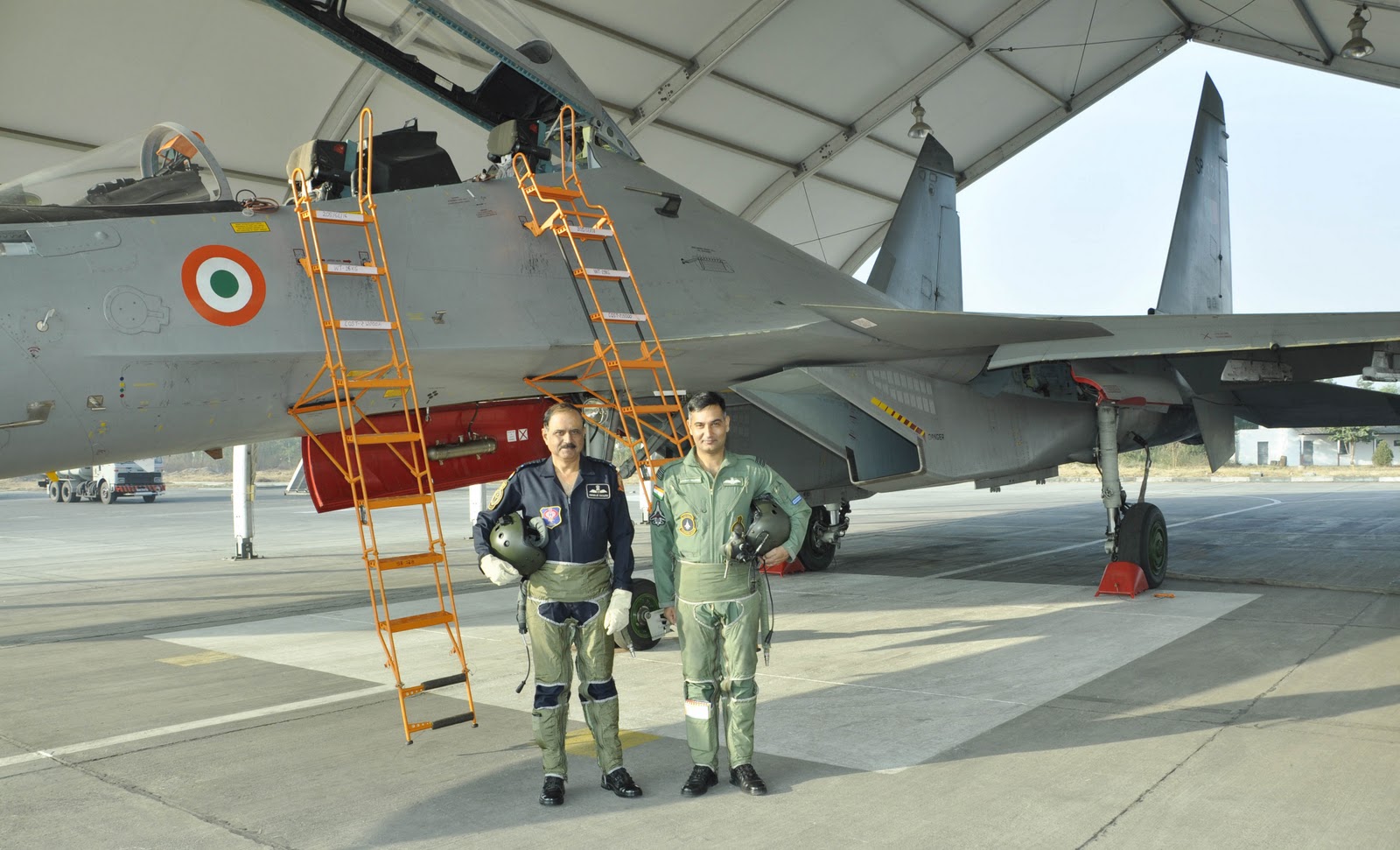
(Photo 1) Air Chief Marshal NAK Browne, Chief of the Air Staff with Wing Commander Anurag  Sharma, Commanding Officer, SU-30 MKI Squadron, before the sortie at Pune Air Base on December 21.  (Photo 2 & 3)  The CAS at the base. Photos: IAF

Air Chief Marshal NAK Browne, Chief of the Air Staff flew a one hour sortie in a SU-30 MKI at Pune airbase today, an official release from CAS' media managers claim.
Quoting the Chief, the release says: "I wanted to be here to not only fly the SU-30 MKI but also to meet all of you and assure you that our SU-30 fleet is in good and capable hands. Our boys have been doing an excellent job and the momentum of building up the new SU-30 Squadrons needs to be maintained. Our people should remain our highest priority because it is then, that a cohesive team translates itself in to a success story.”
The CAS was on a working visit to this base, which he had previously commanded as the Air Officer Commanding (AOC), from 2001 to 2003. During his visit he interacted with the Squadron pilots, engineers and all the station personnel and met the key appointments of the station.
Watch this space for Sukhoi-related news soon. Very soon!

For regular updates, visit: https://www.facebook.com/Tarmak007